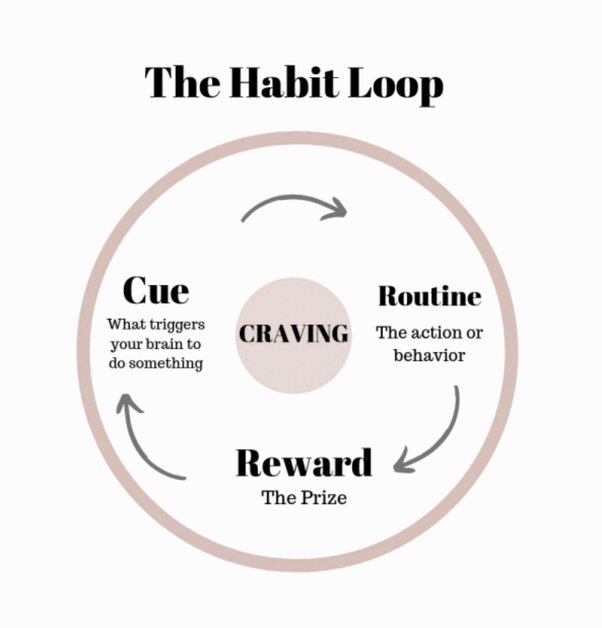
Understanding how your habits function is the first step towards changing them. Most of us are oblivious regarding the majority of our habits because habits are by meaning mindless. They start by a trigger and end with some sort of reward.
I’ll walk you through the basic idea of how habits are formed, which is known as the habit loop.
The process of creating a habit can be divided into four steps: cue, craving, response, and reward.
Every habit is built on this four-step pattern, which your brain repeats in the same order each time.
The first step is Cue: that initiates the habitual behavior. It is also known as the reminder.
They are typically classified as one of the following:
- Location
- Time
- Current emotional state
- People around you
- Your last action
Your mind is constantly analyzing your internal and external environment for indications as to where the rewards are.
The second step is Cravings: they are the driving force behind every habit.
Therefore, Without craving a change, without some level of motivation or desire there are no reason to take action.
Cravings vary from one individual to another. Any little piece of information could cause a craving, however in practice, not everyone is motivated by the same cues. Cues have no meaning unless they are interpreted. The observer’s feelings, thought and emotions are what turn a cue into a craving.
The third step is Response: Which is the actual habit that you perform, it can be a thought or an action.
The fourth step is Rewards: Which close the feedback loop and complete the habit cycle.
A behavior will not become a habit if it falls short in any of the four stages. If you remove the cue, your habit will never start. If you reduce the craving, you will not have enough motivation to act. You won’t be able to perform the behavior if you make it difficult.
And if the reward does not satisfy your desire, you will have no reason to do it again.
A feedback loop best describes the four stages of habit. They form an endless cycle that runs at every moment, even now. This “habit loop” is constantly scanning the environment, forecasting what will happen next, experimenting with various responses, and learning from the outcomes. The entire process is completed in a fraction of a second, and we repeat it without realizing.
Growing up, we rarely pay attention to the habits that are part of our lives. For example, most of us don’t think twice about changing into comfortable clothes when we get home from work. We automatically fall into these patterns of thinking and acting as a result of decades of mental programming.
However, once your brain begins to connect that particular behavior with a reward, you will build a craving for it, even if you are unaware of it.
First, an incident happens in your life, either positive or negative. For instance, how does it feel to eat a good piece of ice cream? Your brain feels good, satisfied, and wanting more, so you keep that good feeling going so your brain remembers, and the next time you want to feel better and good, you eat some ice cream.
So now you start to associate ice cream with feeling good. And this is when craving starts.
The next time you see ice cream you start to crave it, even if you are not that hungry. The more you do it, the more you will be creating this habit loop.
When you are stressed, sad, or angry, you develop cravings for ice cream or whatever your comfort food is. The tricky thing is that the more you do it, the more it becomes a habit.
Over time you’re not even consciously choosing these actions anymore, it’s like you are an automatic pilot, you’re not even flying the plane.
That means, the more regularly you do something, the more likely you’ll stick with that behavior over time.
We can turn these four steps into a practical framework for creating good habits and eliminating bad ones.
How to create a Good habit?
- Make the cute obvious
- Make the craving attractive
- Make the response easy
- Make the reward satisfying
How to break a Bad Habit?
- Make the cute invisible
- Make the craving unattractive
- Make the response difficult
- Make the reward unsatisfying
Though the process has multiple steps:
- Identify the routine
- Try different rewards
- Explore your triggers
- Find a way around those cues
Take note of any possible cues whenever you find yourself repeating your routine. Making a list of potential triggers can help you notice them more clearly and recognize any patterns.
Try this for a few days, then review your notes to see if anything stands out.
The important point to remember is that, while habits establish quickly, they are not broken overnight. Making a commitment to your new routine for a month will help it stick.
Finally, take into consideration your motivation. If you don’t want to change, it will be difficult to break the cycle.
By interrupting your habit loop you are developing productive routines that still provide rewards.
If you want to change habits, you must first weaken the craving. You can do so by instilling a desire to quit or by providing the evidence that it is highly harmful to your health.
If you’ve ever wondered, “Why don’t I do what I say I’m going to do?” Why don’t I lose weight, quit smoking, start a side business, or save for retirement? “How come I always say something is important but never seem to make time for it?” The answers to those questions can be found in one of the four laws. Understanding these fundamental laws and how to modify them to your specifications is the key to developing good habits and breaking bad ones.
Being open and aware is the first step in learning and understanding the habit loop. Start to observe, even track, one current habit over a period of time.
After identifying bad habits, the next step is to replace them with more beneficial ones.
Identifying the cue and substituting a more positive reward and outcome.
Before moving forward, I recommend going backwards and identifying the reward behind your habit. On your way to the refrigerator, what need are you trying to fill or numb? Do you require an energy boost? Are you attempting to avoid something that is bothering you?
When you understand what need this habit is attempting to meet, you can replace it with a different behavior that will assist you in achieving and maintaining your health goals without jeopardizing them.
Change is not easy, simply because you’re used to do the same thing you’ve always done, and it can be challenging to cease doing them.
“IF YOU WANT TO MASTER A HABIT, THE KEY IS TO START WITH REPETITION NOT PERFECTION”
 Vitality Blueprint